
Latest Podcasts
Please find below a range of topics on mental health for you to watch and listen to.
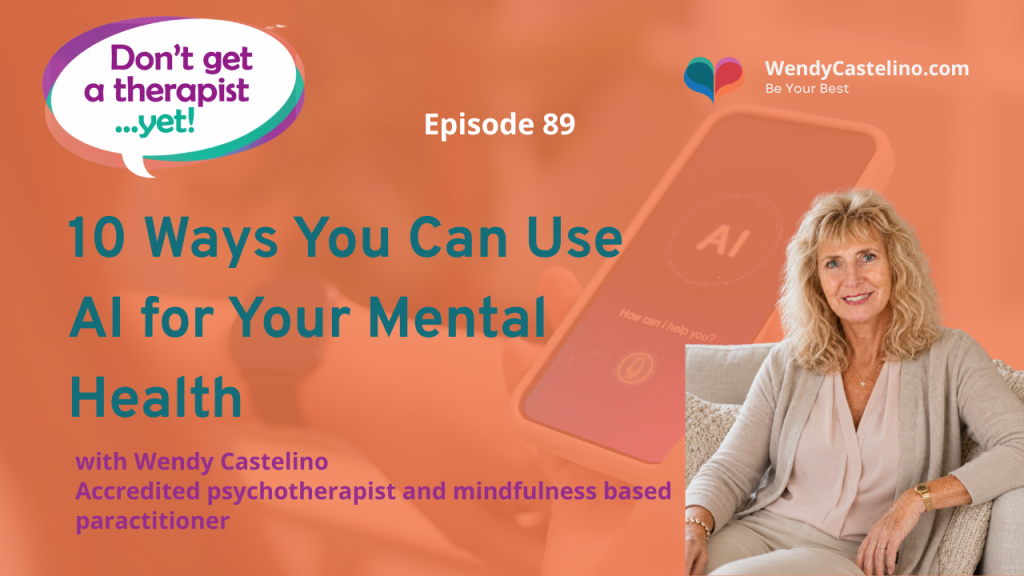
Using AI for Your Mental Health: 10 Safe Ways to Use It (and 7 to Avoid)
More people are turning to AI for their mental health than ever before, especially when there’s no time to book an appointment or sit with a problem for hours. If you’ve found yourself typing out how you’re feeling instead of searching the internet for answers, this episode is built for you.
Why People Are Turning to AI for Support
Life doesn’t leave much room for processing things properly. Between work, family and everything in between, a lot of people are reaching for AI to get through the harder moments: an anxious thought before a meeting, a spiral of worry at 11pm, a mind that’s gone blank before a therapy appointment. Used well, AI can genuinely help with all of that. Used badly, it can pull you further into the exact patterns you’re trying to break.
This episode walks through both sides, so you know which is which.
10 Practical Ways to Use AI for Your Mental Health
Drawing on real therapy models such as CBT, ACT, compassion-focused therapy and behavioural activation, this episode gives you exact prompts you can use straight away, including how to:
- Challenge an anxious thought using CBT, rather than let it spiral unchecked
- Turn a chaotic worry into a practical, four-week action plan
- Build a graded exposure plan for something you’ve been avoiding
- Structure a careful ERP approach if OCD is part of the picture
- Write a compassionate response to yourself after a mistake
- Create a behavioural activation plan when motivation has disappeared
- Sort your worries into what’s practical and what’s simply uncertain
- Clarify what actually matters to you using an ACT-based values exercise
- Learn quick grounding and emotional regulation techniques
- Prepare properly for your next therapy session
Where AI for Your Mental Health Has Real Limits
This is the part most people skip past, and it’s the part that matters most. AI cannot read your body language, hold your history, or take responsibility for your care. The episode covers seven clear boundaries, including why self-diagnosis is risky, why medication decisions need a real prescriber, and the one rule that matters more than any other: what to do if you’re in crisis. AI is never the right place to turn when safety is at risk.
The Line Between a Useful Tool and a Replacement for Therapy
The episode keeps coming back to one idea: AI can help you ask better questions, but it shouldn’t be making your biggest decisions. A good therapist notices things about you. They remember. They challenge you when you need it, even when that’s not what you want to hear. AI is designed to keep you comfortable, which is exactly why it makes a good thinking partner and a poor substitute for real human support.
Episode Timestamps
- 00:00 – Can you use AI for your mental health?
- 02:49 – What AI is and how it works
- 04:52 – Challenge anxious thoughts using AI and CBT
- 07:41 – Turn a worry into a problem-solving plan
- 10:01 – Build a graded exposure plan with AI
- 12:32 – Structure an OCD ERP plan safely
- 15:22 – Build a more compassionate inner voice
- 17:23 – Behavioural activation for low mood
- 19:12 – Sort practical worries from hypothetical ones
- 20:43 – Clarify your values with AI (ACT prompts)
- 22:15 – Emotional regulation and grounding prompts
- 23:46 – Prepare for therapy using AI
- 25:06 – 7 ways you shouldn’t use AI for mental health
- 25:14 – Don’t use AI to self-diagnose
- 26:10 – Never rely on AI in a suicide or self-harm crisis
- 27:08 – Don’t use AI for deep trauma processing
- 28:24 – Don’t let AI make your medication decisions
- 29:09 – Don’t use AI as a reassurance machine
- 30:24 – Don’t use AI as your only grip on reality
- 31:45 – AI isn’t a confidential relationship
- 33:22 – So should you use AI for mental health?
- 34:30 – 5 AI prompts to take away
- 35:57 – Keep AI in the toolkit, not the whole toolkit
If you’ve been using AI for your mental health without really knowing where the line sits, this episode gives you a clear, honest answer, along with prompts you can use today and the boundaries worth keeping in place.
This episode is for educational purposes and isn’t a substitute for professional mental health care. If you’re in crisis, contact emergency services or a mental health professional immediately.
For more resources on using AI as a mental health tool read my blog The risks of using Chatbots (or AI) for mental health and how to reduce them
For more podcasts subscribe to my YouTube channel

Sign up to access FREE Online Learning Resources
Sign up to our newsletter and we’ll give you our 10 part Sleep Course completeley FREE
