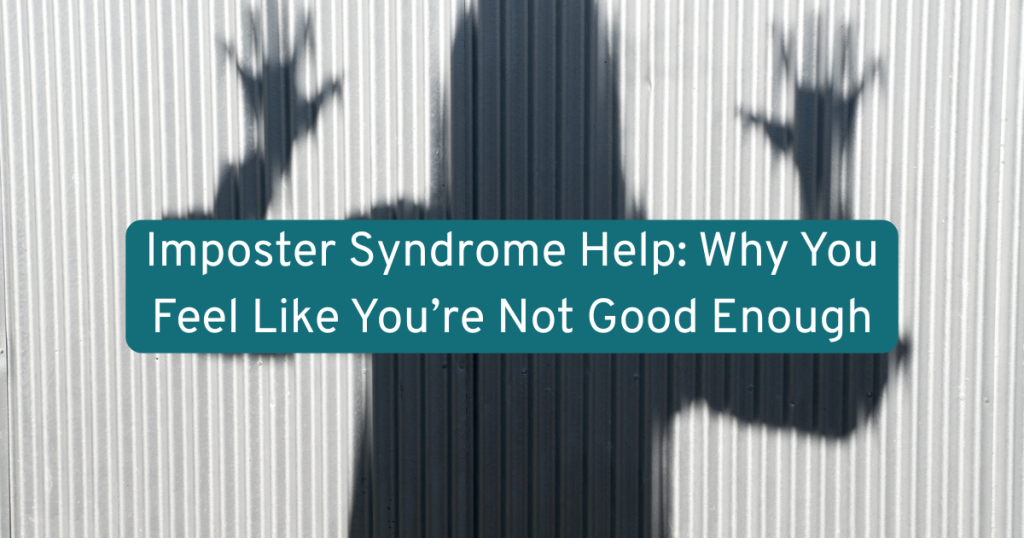
Imposter syndrome help is something more and more people are feeling. It has been on the rise, especially in the past few years.
Imposter syndrome isn’t an actual diagnosis. It’s a pattern of thinking where you doubt your abilities, question your worth, and fear being “found out”, even when there’s clear evidence that you’re capable.
It tends to show up when you grow.
When you step into something new.
When you’re promoted.
When you start your own business.
When you’re surrounded by people you perceive as more confident or more experienced.
Instead of feeling proud, you feel exposed.
What imposter syndrome actually is
At its core, imposter syndrome is a mismatch between your external reality and your internal belief about yourself.
On the outside, you might be achieving.
On the inside, you still feel like the person who isn’t quite good enough.
In my recent podcast episode, Christina Robinson spoke about growing up believing that “less than average would be the best I’d ever be.” Even when she was later offered the chance to buy the business she worked in, her first reaction internally was disbelief. Not excitement. Not confidence. Disbelief.
That’s when people often seek imposter syndrome help, when opportunity doesn’t match identity.
How imposter syndrome makes you feel
It rarely announces itself clearly. It shows up subtly.
You might feel:
- Anxious that someone will realise you’re not as capable as they think
- Reluctant to speak up in meetings
- Driven to overwork to prove yourself
- Unable to celebrate your achievements
- Constantly comparing yourself to others
You can look confident and still feel like an imposter inside.
That internal tension is exhausting.
When you’re most likely to feel like an imposter
Imposter feelings tend to surface at transition points.
Starting a new job.
Raising your prices.
Being visible online.
Leading others.
Changing careers.
Stepping into a room where you don’t see many people like you.
Christina described sitting in her car after signing the paperwork to buy her business, almost in disbelief that she had actually done it. That moment, when you realise your life is expanding, is exactly when imposter thoughts can get louder.
Growth triggers it.
Not failure.
How to change your mindset around it
The first step in any real imposter syndrome help is understanding that the feeling doesn’t mean you’re incapable. It usually means you’re stretching beyond an old identity.
Start by separating facts from feelings.
Fact: You were offered the role.
Feeling: I’m not good enough for this.
Those are not the same thing.
Next, look at the origin of the belief. Ask yourself:
When did I first start believing I wasn’t capable?
Often, imposter thoughts are echoes from earlier life experiences, criticism, low expectations, or environments where you didn’t feel seen.
You can also begin to challenge the pattern gently. Instead of trying to eliminate the feeling completely, try this:
“I feel like an imposter right now, and I’m still allowed to be here.”
Confidence doesn’t usually come first. Action does.
The more you act while feeling unsure, the more your brain gathers new evidence that you are capable.
That’s where real imposter syndrome help becomes powerful, not in forcing positivity, but in building a new internal story through lived experience.
A final thought
Imposter syndrome doesn’t mean you’re a fraud. It usually means you’re growing into a version of yourself you haven’t fully caught up with yet.
The goal isn’t to never feel it again.
The goal is to recognise it, understand it, and not let it decide what you do next.
And that shift alone can change everything.