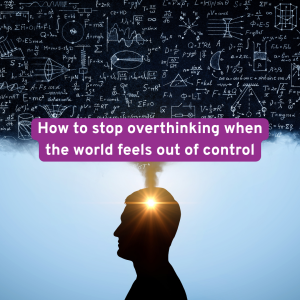
How to Stop Worrying So Much (Without Losing Your Mind)
Let’s face it, we all do it. Worrying about money, work, health, what someone really meant in that text message.
Worrying is that mental hamster wheel we find ourselves on at 3am when all we want is sleep… and instead we’re replaying every awkward conversation we’ve ever had.
Sound familiar?
If you’ve been overthinking, spiralling into “what if” mode, or feeling like your brain just won’t switch off, you are so not alone. In fact, you’re human.
And the good news?
You can actually learn to manage worrying with a few clever tools from CBT (that’s Cognitive Behavioural Therapy) and mindfulness.
Why do we worry so much?
Worrying is basically our brain’s attempt to prepare for danger, even when the “danger” is just a meeting tomorrow or a weird email.
A little worry? Totally normal.
But constant, uncontrollable worrying? That’s when it starts to mess with your sleep, your mood, and your peace of mind.
We often worry because we feel out of control, or because life feels uncertain (hello, post-pandemic world). Our minds race ahead to all the bad things that might happen… and forget to check whether we’re actually in danger (spoiler alert: usually not).
So how do we stop worrying so much?
Meet The Worry Tree
One of our favourite CBT tools is called The Worry Tree. It’s simple, visual, and surprisingly effective.
Start by asking:
Can I do something about this worry?
- If yes → it’s a solvable worry.
- If no → it’s unsolvable (aka outside your control).
Worrying about rain on your holiday? Unsolvable.
Worrying about what to pack if it rains? Solvable!
What to do with Solvable Worries
Use good old-fashioned CBT problem solving:
- Define the problem (Get specific!)
- Brainstorm solutions (No idea is too silly.)
- Weigh pros and cons (What’s practical? What’s not?)
- Make a plan (Break it into baby steps.)
- Take action (Action = anxiety’s worst enemy.)
- Review (What worked? What didn’t?)
The more you practise this, the more capable you’ll feel, and the less your brain will feel the need to worry about everything.
What to do with Unsolvable Worries
Here’s where we use a mix of CBT and mindfulness:
- Challenge the worry:
Ask yourself, “Is this a thought or a fact?”
“Am I imagining the worst?”
“What’s a more balanced way to look at this?”
- Practise mindfulness:
Worrying pulls us into the future. Mindfulness brings us back to now.
Try sipping tea slowly, noticing your breath, or tuning in to your senses.
Each time your mind wanders (and it will!), gently bring it back. Like training a puppy—patience is key.
Bonus Trick: Split the Worry
Some worries are part solvable, part not. Do what you can, then use mindfulness to let go of the rest. It’s not about perfection, it’s about progress.
Worrying doesn’t mean something’s wrong with you. It means you care, you’re human, and your brain is just trying to protect you (even if it’s not always helpful). But you don’t have to stay stuck in it.
CBT tools, mindfulness, and a bit of kindness toward yourself can go a long way in calming that busy brain.
If this feels like exactly what you needed today, you’ll love this podcast episode:
🎧 How to Stop Worrying So Much – CBT Tools That Work
Give it a listen, share it with a fellow worrier, and remember, your thoughts are just thoughts.