Please find below a range of topics on mental health for you to watch and listen to.
Signs of OCD in Children: Dr Aureen Pinto Wagner on Spotting It Early and Helping Without Feeding the Fear
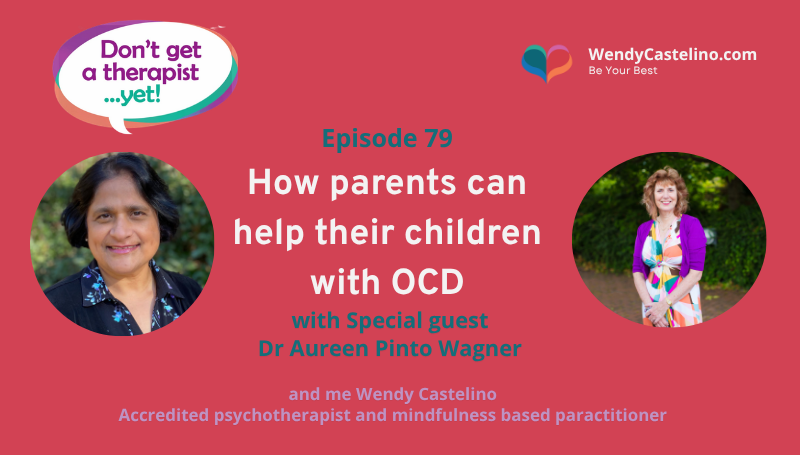
Learning to recognise the signs of OCD in children can feel overwhelming for any parent, especially when the line between normal childhood worry and something more persistent isn’t always obvious. In this episode of Don’t Get a Therapist Yet, I’m joined by Dr Aureen Pinto Wagner, a clinical child psychologist with over 25 years of experience treating childhood OCD, director of The Anxiety Wellness Center in North Carolina, and author of Up and Down the Worry Hill.
What Are the Real Signs of OCD in Children?
We start by unpacking what actually separates normal childhood worry from something more. Dr Wagner introduces her “four Ds” framework: disproportion, disruption, distress, and duration, a genuinely useful guide for any parent wondering whether what they’re seeing warrants a closer look. We also talk through the early signs of OCD in children that tend to get missed, from sudden personality shifts to compulsive confessing and apologising.
Obsessions, Compulsions and the Ones You Can’t See
Dr Wagner walks through the different faces of childhood OCD, from the classic hand-washing and checking rituals to the far less visible mental rituals: counting, silent repeating, and “just right” behaviours built around symmetry and completion. We also spend real time on intrusive thoughts, including the frightening or taboo ones many children feel too ashamed to say out loud, and why these thoughts are actually a normal part of the human experience for almost everyone.
Reassurance Seeking and the Cycle That Keeps OCD Going
One of the most useful parts of this conversation is Dr Wagner’s explanation of why answering a child’s repeated questions, however instinctive it feels, can unintentionally strengthen their OCD over time. She walks through the escape-and-avoidance cycle in simple terms any parent can follow, and offers a gentler way to respond that still validates a child’s fear without feeding it.
ERP Therapy: The Gold Standard for Childhood OCD
We go deep into Exposure and Response Prevention, or ERP, widely regarded as the most effective treatment for childhood OCD. Dr Wagner shares her Worry Hill analogy, a simple, child-friendly way of explaining why facing a fear feels hard in the moment but builds real, lasting confidence on the other side.
Supporting a Child Through an OCD Meltdown
Dr Wagner also offers a genuinely practical three-phase approach for meltdowns: what to do before, during, and after. Her explanation of why the “thinking brain” temporarily goes offline during a meltdown, and why stepping back rather than reasoning is the more effective response, is one every parent will want to hear.
Hope for Families Living With Childhood OCD
This episode closes on real encouragement. ERP treatment has a 60 to 80 percent success rate, and with the right support at the right time, children can move forward into a genuinely full and steady adulthood. If anxiety more broadly is something your family is navigating, my page on anxiety and stress support has further resources alongside this episode.