

Latest Podcasts
Please find below a range of topics on mental health for you to watch and listen to.
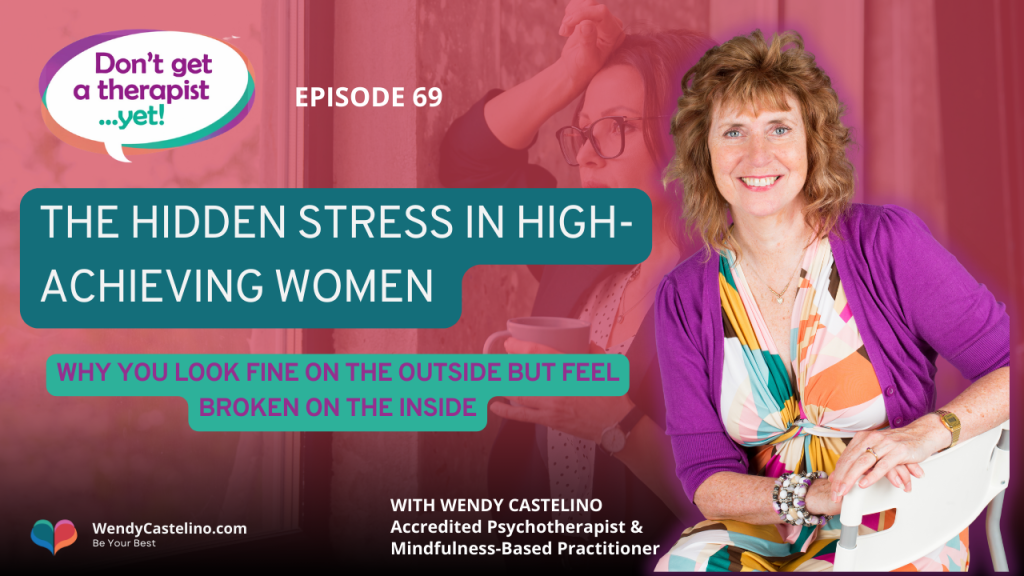
Why high-achieving women look fine but feel broken inside
High-achieving women are some of the most capable, dependable and quietly exhausted people in the room.
You are functioning. You are working. You are remembering the school emails, hitting the deadlines, being kind, being capable, and keeping everything moving. From the outside, you look strong, organised and completely in control.
But inside? You feel exhausted, brittle, numb, snappy, ashamed, lonely or quietly overwhelmed. Something feels like it is fraying, even while your life looks perfectly fine on paper.
If that sounds familiar, you are not alone, and you are not broken.
In this episode of Don’t Get A Therapist Yet, we explore one of the most common and most hidden struggles facing high-achieving women today: the painful gap between the mask they show the world and how they truly feel on the inside.
This is a conversation about what happens when competence becomes your identity, self-reliance is praised above everything else, and asking for help starts to feel genuinely threatening.
Why do high-achieving women hide how they really feel?
Women are not bad at coping. They are carrying a heavy and often hidden load of paid work, unpaid care, emotional labour and invisible planning.
Add to that the pressure of managing how you come across while stressed, staying pleasant, staying calm, staying reassuring for everyone else, and it becomes clear why so many high-achieving women are running on empty while still appearing completely fine to the outside world.
There is also a deeper psychological layer at work. When your sense of worth becomes tied to being competent, productive and needed, admitting that you are struggling can start to feel like a threat to your entire identity. For many women, silence feels safer than honesty, especially when they have reached out before and been dismissed, minimised or told they are overreacting.
What feeling broken inside actually looks like
Feeling broken looks entirely ordinary from the outside. It can look like:
- being permanently tired but unable to switch off
- Crying in private
- Snapping at the children and then drowning in guilt
- Smiling in meetings and then collapsing on the sofa afterwards
- Lying awake at night replaying every conversation
- Feeling flat, numb or strangely detached from your own life
- Overthinking small decisions because your brain feels completely overloaded
It can also look like functioning well enough that no one around you realises how much you are suffering. That is part of what makes this so painful.
Many high-achieving women do not look unwell enough to others to justify support, even though inside they feel close to the edge.
The vicious cycle of overload, self-criticism and burnout
This struggle often becomes a self-perpetuating loop. She feels overwhelmed. Because she values competence and fears judgment, she hides the struggle. Because she hides it, she gets less support. Because she gets less support, the load becomes heavier. Because the load becomes heavier, she becomes more exhausted and emotionally stretched.
Then she criticises herself for not coping better and pushes even harder to prove she is fine. That extra pushing creates more depletion, and round it goes.
Evidence-based therapy skills that can actually help
Drawing on CBT, ACT, Compassion Focused Therapy, DBT and mindfulness, This episode shares practical, evidence-based skills designed to help high-achieving women break the cycle, ease the pressure and start responding to themselves with a little more honesty and compassion.
In this episode you will discover:
- Why high-achieving women feel such intense pressure to always appear strong
- What feeling broken really looks like in everyday life, and why it often goes unnoticed
- How emotional labour silently drains women’s mental health and energy
- Why asking for help feels so hard, and the small steps that can make it easier
- CBT tools to identify and challenge the pressure thoughts keeping the cycle going
- ACT skills to stop fighting your feelings and reconnect with what truly matters to you
- Compassion Focused Therapy techniques to quieten your inner critic and ease shame
- DBT strategies for managing emotional overwhelm and flooding in the moment
- Mindfulness practices to step out of survival mode and break the autopilot cycle
- A realistic, practical daily and weekly reset plan you can actually stick to
Because feeling broken is simply a sign that your mind, body and nervous system have been carrying too much, for too long, with too little room for honesty, support, rest and compassion.
And we can change that.
For more on stress, anxiety, burnout and work-related stress, visit my Blog Page


Sign up to access FREE Online Learning Resources
Sign up to our newsletter and we’ll give you our 10 part Sleep Course completeley FREE
