

Latest Podcasts
Please find below a range of topics on mental health for you to watch and listen to.
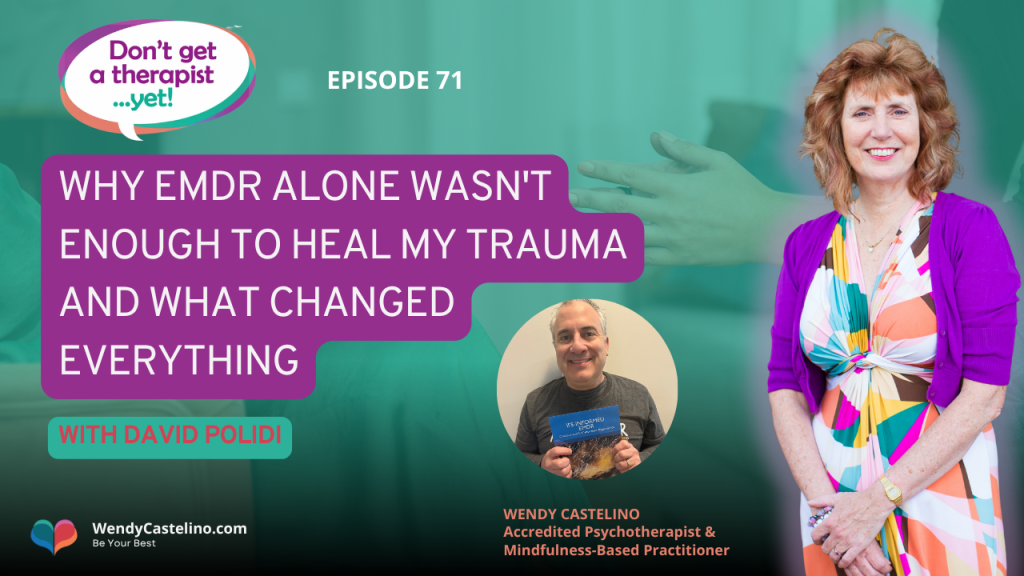
How to Find Trauma Therapy That Works
Finding trauma therapy that works for you starts with finding the right therapist and the right process. Sometimes the therapy you are going through right now just isn’t working, or sometimes it is that you just don’t click with your therapist. There are numerous reasons why it may not be working for you, but don’t give up just yet.
In this episode of Don’t Get A Therapist Yet, I sat down with David Polidi, social worker, therapist, author, and editor of the ground-breaking book IFS Informed EMDR: Creative and Collaborative Approaches. David shares his own personal journey of sitting on the client’s side of the couch, trying EMDR and feeling absolutely nothing, and eventually discovering why his own protector parts were blocking the process without him even knowing.
Why so many people try therapy and still feel stuck
One of the most powerful moments in this conversation comes when David describes his own experience as a therapy client. He had heard about EMDR, sought it out, sat in the room, and felt nothing.
Inside his nervous system, without him consciously knowing, his protector parts had put their hands up. They weren’t ready to be that vulnerable. And so the bilateral stimulation of EMDR that should have been processing old trauma just hit a wall.
This is something so many trauma survivors experience and never have explained to them. You sit in the therapy room. You do the thing. And nothing moves. And you walk away thinking you are broken, or that therapy doesn’t work, or that your trauma is somehow too big or too stuck to shift.
But that’s not what’s happening. What’s happening is that a part of you is doing exactly what it was designed to do, keep you safe.
Why does EMDR stop working
EMDR stands for Eye Movement Desensitisation and Reprocessing.
When we go through a normal experience, our brain metabolises it, extracts what it needs, and lets the rest go. But when we experience trauma, we are so overwhelmed, so flooded, so out of control, that our brain’s natural processing system gets disrupted. The memory gets stuck. The energy of that traumatic moment stays lodged in the body.
And then years later, sometimes decades later, a smell, a sound, a tone of voice sends us straight back there. As a felt experience.
EMDR uses bilateral stimulation, eye movements, tapping, sound moving from ear to ear, to reactivate that stuck processing system and help the brain finally do what it couldn’t do at the time. In the safety of the present moment, with a trusted therapist, the old material finally gets metabolised.
But here’s what David discovered. If a protector part doesn’t feel safe enough to let that process happen, then EMDR hits a wall, and that is exactly where Internal Family Systems (IFS) can change everything.
What is IFS
Internal Family Systems, or IFS, is a trauma model built around the idea that we all have multiple parts inside us. (Remember the film Inside Out?) This is simply the natural, healthy multiplicity that exists inside every human being.
Joy, Sadness, Anger, Fear, Disgust. IFS says we all have an internal family, a little like that. Parts that protect us, carry our pain, and have been doing an exhausting job keeping us functioning for years.
And crucially, there are no bad parts. Every single part, no matter how destructive it might look from the outside, is doing something it believes is keeping you safe.
This reframe alone, that the parts blocking your healing are your protectors.
How IFS and EMDR work together
So what happens when you bring these two models together? David describes it as layering two maps of the same internal landscape on top of each other. Suddenly you have more precision. More depth. More understanding of exactly where you are and what is needed.
In practice, IFS informed EMDR means that before diving into trauma processing, the therapist works to understand which parts are present.
Which protector parts might be blocking the work? What do they need to feel safe enough to step back?
And once there is enough trust and safety, the EMDR can reach the deeper, more vulnerable parts, the exiles, as IFS calls them, the young wounded parts that have been carrying the original pain.
This episode is for you if
- You have been carrying trauma for years and don’t know where to begin
- You tried EMDR and felt like nothing happened
- You are in therapy but something just isn’t clicking
- You want to understand what IFS and EMDR actually are in plain human language
- You are a therapist looking to understand how these two models work together
- You simply want to feel less alone in your healing journey
Watch now
You can watch the full episode above and find more podcast episodes on my YouTube. Want to learn more about trauma or EMDR? Read my blog page
And if this conversation resonates with you, please share it with someone who needs to hear it.


Sign up to access FREE Online Learning Resources
Sign up to our newsletter and we’ll give you our 10 part Sleep Course completeley FREE
